
What two cohorts taught me about service design maturity
Same training, different outcomes
This spring, I ran the Introduction to Service Design course for two very different cohorts: one from Citizens Advice, the other from The City of London Corporation.
Same course. Similar materials. Two strikingly different sets of takeaways.
The contrast got me thinking about something useful for any transformation leader considering training. Where your team sits on the user-centred design maturity curve shapes what they'll get out of training, and which next steps will emerge from the experience.
What people said at the start
I always begin the course by asking participants to complete the sentence:
"I'll be satisfied at the end of this course when..."
Across both cohorts, the answers were strikingly similar. People wanted to understand what service design actually is, apply it in their own context, build the confidence to communicate and advocate for it, and learn how to identify problems and articulate outcomes.
That's the bar I'm aiming for by the end of session three. The harder question is what people will actually do differently afterwards.
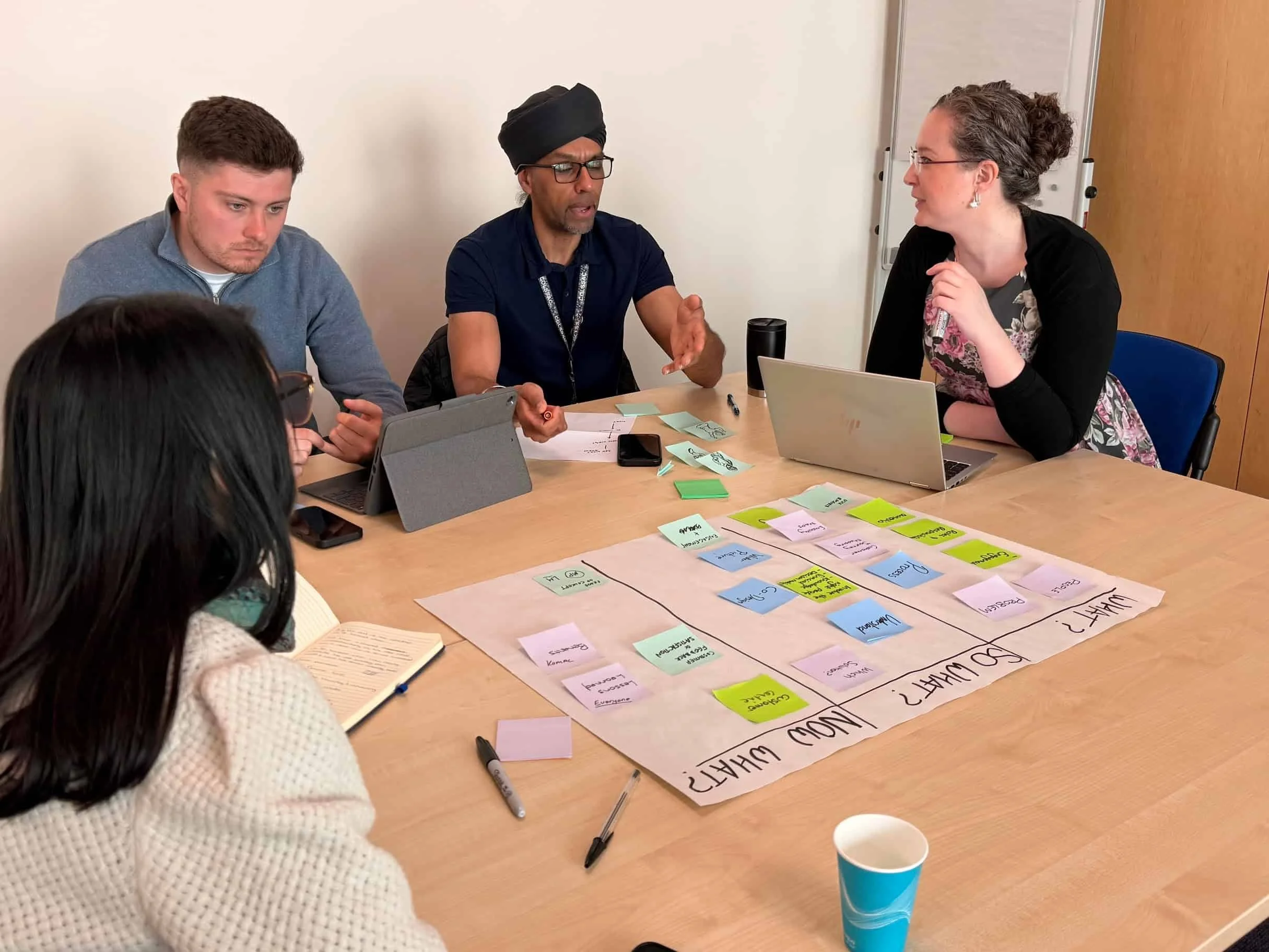
City of London workshop in action
Two different "Now What's"
In the final session, we run a structured reflection called What, So What, Now What - it’s a facilitation method from Liberating Structures.
The "Now What" is where intent meets reality. What actions will participants take next? It’s designed to close what I call the “knowing doing gap”.
Here's where the contrast jumped out.
The City of London cohort gravitated towards the early phases of the design process. Their commitments clustered around capturing lessons learned from previous projects and baking those into the kick-off of new ones.
They wanted to ask better questions at the request stage, get the right people involved earlier, and resist the pull towards a solution before the problem was properly defined. One participant committed to "asking more questions during the ‘new request’ stage, fleshing out the business case, and looking at alternative solutions." Another wanted to "review existing processes to check they're fit for purpose."
The energy was about being more deliberate at the start.
The Citizens Advice cohort gravitated somewhere else entirely. Their reflections returned again and again to what happens further along in the design process: iteration beyond launch, designing services holistically rather than in silos, and bringing users into the journey beyond the testing phase.
People talked about how "we don't tend to involve users throughout the whole process" and committed to building sprints into their next project to allow for quick iteration.
Several made plans to advocate for time after delivery to keep iterating, and to involve users in research analysis rather than just data collection, signalling a move towards co-design.
What this tells me about design maturity
I think the contrast says something useful about design maturity and what similar training experiences deliver as a result.
When teams are newer to user-centred design, the most useful gains usually live in the first half of the process. People learn to slow down at the start, define the problem better, and resist the pull towards a solution. The shift is from "let’s build this solution" to "what are we actually trying to fix here?"
When teams are further up the maturity ladder, already doing user research and already involving users in early testing, the next gains tend to live in the latter phases of design, including iteration after live. Closing the loop with users. Treating services as ongoing rather than as projects with an end date.
Neither cohort got it wrong. Both arrived at exactly the right set of next steps for where they are right now. The same training delivered genuinely different value to each team.
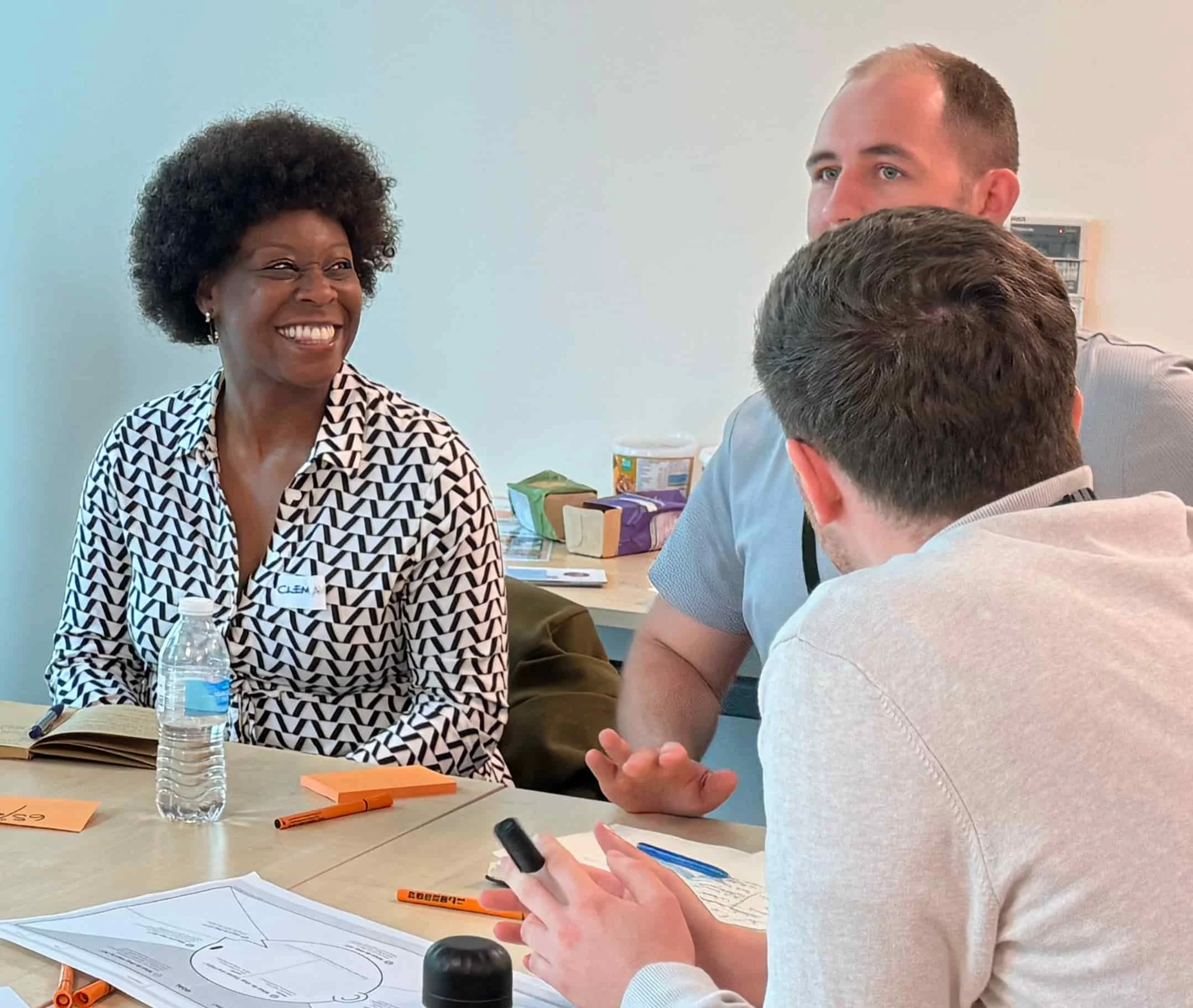
City of London workshop
The shared language effect
When a team learns this stuff together, they leave with a shared language, a shared experience, and a shared frame of reference.
Afterwards, someone can say,
"what is the riskiest assumption?" or
"who are our users and what do they need?"
and colleagues just get it.
You skip the part where one person has to translate ideas back from a course nobody else attended. And you don’t have to hear the dreaded “I’ve just been on an amazing course and…” 🤚
The bigger effect comes from the momentum created by multiple people committing to micro-actions after the training. What we call 15% Solutions - again from Liberating Structures.
These are small actions individuals can take without permission or extra resources. When a whole team commits to a few of these in the same week, you get something better than the sum of the parts.
Someone champions the user.
Someone else challenges risky assumptions.
Someone insists on framing the problem before jumping to a solution.
Someone else asks better questions in a stakeholder meeting where they would previously have nodded along.
Suddenly, the team is moving in the same direction together.
If this rings true
What I find quietly satisfying about running this course is that it seems to work for teams at very different stages of maturity. People take what is most useful for where they are, and learning together turns that into shared momentum.
If you are curious about what your team would get out of it,Introduction to Service Design runs as an open online course a couple of times a year, and is also available for in-house delivery with your own team.
It’s designed and delivered by me, an SDN Accredited Master Trainer in Service Design, and is made specifically for public and third-sector organisations.
